Double Pointed Needles
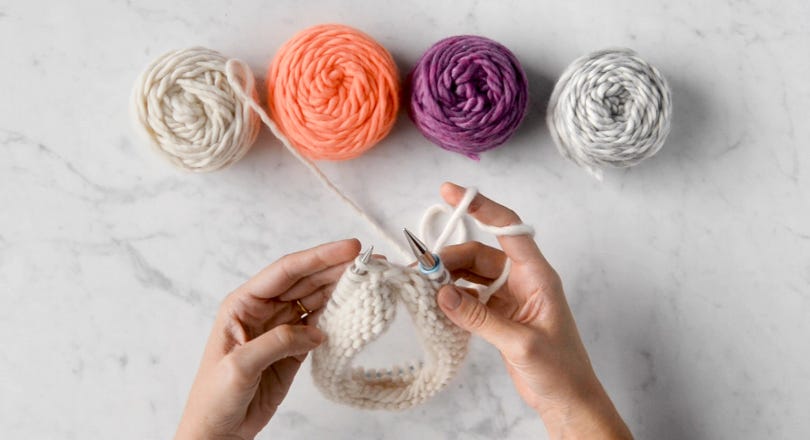
The dreaded double pointed needles! Learning to use double pointed needles is probably the biggest leap a beginner knitter can take into the world beyond scarves. Hats, sleeves, mittens, gloves, socks... all pretty much require the use of double pointed needles. So if you're ready, here we go!
An Overview
Double pointed needles are used to knit things in the round that are too small for circular needles. For example, when you knit a hat on a circular needle, toward the top of the hat the stitches become so few that they no longer reach around the circular needle. At that point you need to switch to double pointed needles. Other projects start out too small for circular needles, like the Toadstool Baby Rattle, which is the project this tutorial is illustrating.
If you've never knit anything in the round before, it's very important to know that you never turn your work around when you knit circularly. In other words, the right side of the fabric always faces you. The major consequence of this is that some stitch patterns are different in the round than they are flat. For example, to knit stockinette stitch in the round you only use the knit stitch; you never purl. As you gain experience, this concept won't sound so complicated!
Double pointed needles come in a pack of five, but the knitting tradition in America is to usually use only four at a time. Three needles hold the stitches while a fourth knits them. Sometimes you do use all five, four to hold the stitches and the fifth to knit. This would come in handy when the pattern increases or decreases in multiples of four or if you can't fit all the stitches onto three. Either way, the instructions are basically the same, but this tutorial illustrates the more common use of four double pointed needles.
And, finally, I painted my double pointed needles four different colors to help you keep track of which needle is doing what!

Casting On
Cast all the stitches onto one double pointed needle. Try to cast on somewhat loosely, so that the stitches are able to slide freely on the needle.

Then slip 2/3 of the stitches onto a second double pointed needle. (In this case, there are 72 cast on stitches, divided by 3 = 24 x 2 = 48.)

Slip 1/2 of the stitches from the second needle onto a third double pointed needle. Each needle now holds a third of the total number of cast on stitches (24 stitches on each needle). (If the cast on is not exactly divisible by 3, then just have one more or less stitch on one needle.)

Join into the Round
In order to join for working in the round, you need the needle where tail and yarn are coming from (the "white" needle) in your right hand. This usually requires that you flip everything around, the needle in your left hand switching with the needle in your right hand.
Arrange the stitches so they are all facing the same way and aren't spun around on any of the needles.
Insert the fourth (empty) needle into the first stitch of the left needle.

Firmly knit the first stitch.
You're joined into the round!
Knitting with Double Pointed Needles
Continue to knit across the stitches of this first needle. Just pretend that you're knitting with two needles instead of four!

Having knit across all the stitches of the first needle, that needle becomes free to knit the stitches of the next needle. For example, the green needle knit all of the stitches of the yellow needle, freeing the yellow needle to now knit the stitches of the pink needle.

Keep knitting around and around, three needles holding the stitches, one needle knitting. (The first round is the trickiest because the needles tend to squirm around a bit. Don't despair! It gets easier!)
Tips and Details
End of the Round Marker
You don't usually need a marker to indicate the end of the round when you use double pointed needles. Instead, the end of the round is marked by the cast on tail. The first stitch of the needle where the tail comes from is the first stitch of the round.
If, occasionally, you do need a marker, it's easier to put it after the first stitch so that the marker doesn't keep sliding off the needle. Just remember that the first stitch is actually the one before the marker.
The First Stitch of Each Needle
If the first stitch of a new needle is a knit stitch, then make sure that the needle you're knitting with is situated under the previous needle (in this photo, the yellow needle is positioned under the green one, ready to knit the first stitch of the pink needle.)
This helps to prevent a column of loose stitches at the intersection of the needles.

If the first stitch on the needle is a purl stitch, then it's better to start the new needle above the previous needle.

Also, always give the first stitch of each needle a bit of an extra tug to close the gap between needles.
Decreasing
If you need to decrease at the end of a needle and only have one stitch left on the needle,

then slip that 1 stitch to the next needle, and do the decrease at the beginning of the next needle.

That's about it! Good luck with this new skill. I hope that it opens many knitting doors for you!


July 25, 2008
Reader Comments (59)
Thanks.
Thank you :)
I'm so excited to try and make a hat as a Christmas gift... I'm not sure I can wait for the painted tips of the needles to dry LOL! That is a clever idea though... I'm going to try and be patient.
Thanks again... truj
Cant wait to have a go with this, might take me a few tries but at least with your pictures I should be able to work out whats what!
Thank you !! x x
Thanks
It's totally normal for there to be a "gap" at the beginning of the first round. Believe it or not, as you continue to work the gap does minimize, although usually you're able to really tighten it when you weave in the cast on tail. It sounds like you're starting to work in the round part way through the project and so don't have this luxury. So, you may try knitiing the first stitch of the first round through the back loop to help close the gap a little bit more.
As far as getting your needles twisted, I'm not sure I have a magic solution except practice. It may help to focus on just the two needle you're actually knitting with instead of trying to keep all five organized at once!
Please let us know if we can give you any more tips and good luck!
Whitney
I cannot wait to put it into practice this avo.
I understand and love the idea of coloured needles, i can see myself doing the same as a beginner in Double pointed needles.
I basically need this for Hats and Berets to have a seamless professional look as oposed to sew in seam.
Shirley
Thanks for all of the help, and encouragement..
Thank you for this fantastic tutorial.
I think I get it, but I still don't understand one of the first steps--
Once you've distributed your stitches by slipping them onto the other two needles, how do you flip your work so that the tail is on the right hand, while keeping the 'right' side facing you?
After that I'm golden... I think.
Thanks again!
When you situate your needles to join into the round, it may help you to not think about the right side facing you. I never do! What should really be concerning you is that the needle with the last stitch you cast on (with the working yarn) is in your right hand and the needle with first stitch you cast on is in your left hand. The rest just works itself out!
Good luck - please let me know if I can clarify further!
Whitney
Thankyou! Fern xxx
My first project turned out with the knits (chevons) on the outside of the tube. When I tried making the same project again, the knits were on the inside of the tube. I've started and re-started many times to no avail. Any ideas on what I might be doing wrong?
It sounds like you're knitting inside out which is pretty common for double pointed needle beginners. This happens when you join for working in the round. Make sure that the first stitch you knit is the first stitch of your cast on (instead of the last stitch, which is what I think you're doing).
If you realize you're knitting inside out and don't want to start over, try just turning the work right side out and see if you can continue on your way. Usually you can!
Please let us know if you need more help and good luck!
Whitney
Holding the yarn in the left hand makes surprisingly little difference! Continental knitters (which is what you're called) should follow the directions just as they're written. When you join to work in the round you still want the yarn to be coming from the right needle (so, yes, flip) and you still want to knit clockwise.
I hope you get the hang of it. Please let me know if you have any more questions and thanks for these!
Whitney
Thanks again, Lisa x
I'm so glad you're on the road with double pointed needles! A slight ladder is not inevitable, but it eliminating it may be a matter of lots of practice. Besides making sure that the working needle is situated above or below the right hand needle (depending on whether you're knitting or purling) and giving a little extra tug on the first stitch, another tip I've heard is knitting the first stitch of each needle through the back loop. This does take up tension, but it also adds a twist to that stitch which is almost as visible as the ladder! Also wool yarn will cause fewer ladder problems than more slippery yarns like cotton or cashmere. Likewise, with bamboo needles you'll be able to control slippage a little more easily than with metal needles. And, again, practice!
Thanks for your question. Good luck!
Whitney
Can you be more specific about what your problem is? Do the stitches fall off? Do you knit them out of order?
Thanks-
Molly
It's just acrylic paint. Thank you for writing in.
Molly
Yes, manipulating so few stitches on double pointed needles can be quite awkward! You might prefer to cast your stitches onto one needle and to knit the first few rounds back and forth in rows. After a few rows, it'll be much easier to join into the round and to continue on your way. You can use your cast on tail to sew up the tiny seam.
I hope this helps, because there really is no magic trick for working a small number of stitches on dpn's, except a lot of patience and a few deep breaths!
Thanks for your question and good luck!
Whitney