Very Special Scarf: Lovely Leaf Lace

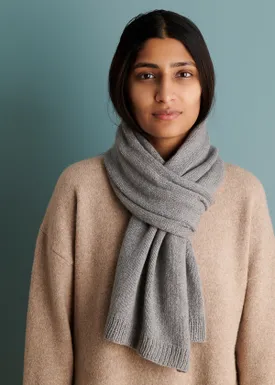
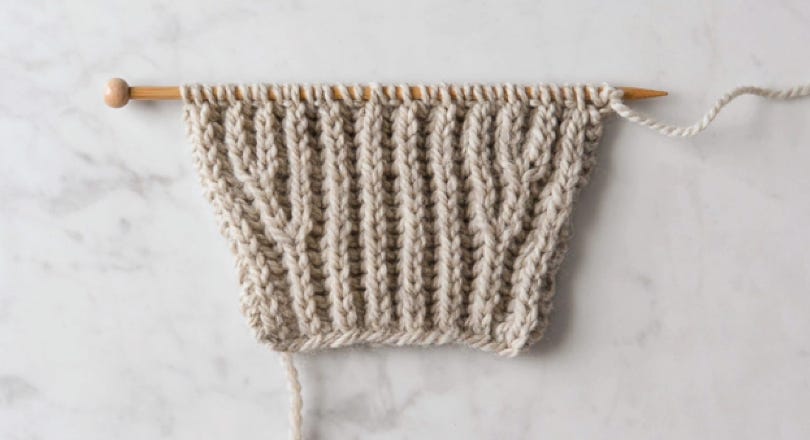
This Lovely Leaf Lace scarf is made with Lobster Pot's 8-ply cashmere in color "Chatham Light". The stitches that create this beautiful and dimensional pattern are a simple combination of strategic yarn-overs and decreases. The lace pattern has a wonderful dimensionality while the stockinette pattern curls around your neck like a big soft hug.

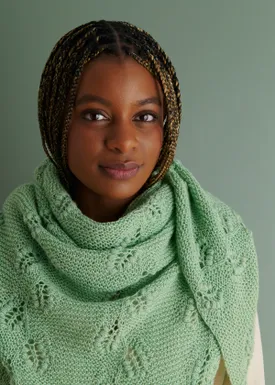
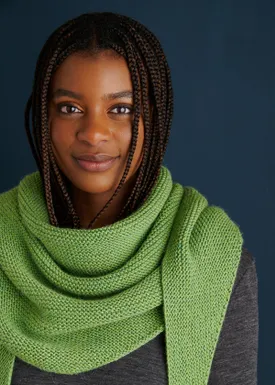
If you're curious about the green scarf on the left you can find the complete instructions for it at this link:
Materials

- 6 skeins 8-ply cashmere, this scarf was made with Lobster Pot's beautifully hand dyed Worsted Weight Cashmere in color "Chatham Light". This scarf would also be beautiful in just about any of our worsted weight yarn (you'll need 600 yards to complete the project).
- US size 9 needles (or size required to get gauge).
Gauge
4 stitches per inch in stockinette stitch
Finished Measurements
Approximately 12 inches wide x 52 inches long
Pattern Notes
- This pattern is a lace leaf pattern at each end, and stockinette in the middle. You should know ahead of time that this scarf curls up on the edges, which makes it fit nicely around your neck, but it is wide enough that its not too skinny, even curled up.
- Stitch pattern is a multiple of 10 + 1
The Pattern
Cast on 61 stitches.
Row 1 and all odd number rows (wrong side): Purl
Row 2: K3, *k2tog, yo, k1, yo, ssk, k5 repeat from *, end last repeat k3.
Row 4: K2, *k2tog, k1, yo, k1, yo, k1, ssk, k3; repeat from *, end last repeat k2.
Row 6: K1, *k2tog, k2, yo, k1, yo, k2, ssk, k1; repeat from * to end.
Row 8: K2tog, *k3, yo, k1, yo, k3, sl 1, k2tog, psso; repeat from * to last 9 stitches, end last repeat k3, yo, k1, yo, k3, ssk.
Row 10: K1, *yo, ssk, k5, k2tog, yo, k1; repeat from * to end.
Row 12: K1, *yo, k1, ssk, k3, k2tog, k1, yo, k1; repeat from * to end.
Row 14: K1, *yo, k2, ssk, k1, k2tog, k2, yo, k1; repeat from * to end.
Row 16: K1, *yo, k3, sl 1, k2tog, psso, k3, yo, k1; repeat from * to end (if you're wondering how to "sl 1, k2tog, psso", please see the detailed instructions below).
Repeat rows 1-16 five times more, work should measure approximately 16 inches from cast on edge, then:
Row 1 (wrong side): Purl
Row 2 (right side): Knit
Repeat these two rows until stockinette portion measures approximately 12 inches or you have used the first 3 skeins of yarn. Place these 61 stitches on a holder or spare needle and work the second half of the scarf the same as the first.
Use kitchener stitch to invisibly graft live stitches from each end together in the center of your scarf.
Weave in ends. Hand wash gently with a mild soap and allow to air dry. I don't recommend blocking this scarf too dramatically because you will flatten the wonderful dimensionality of the lace portion of the scarf. When you lay it out to dry try to encourage the lace portion to retain its depth rather than stretching it out flat.
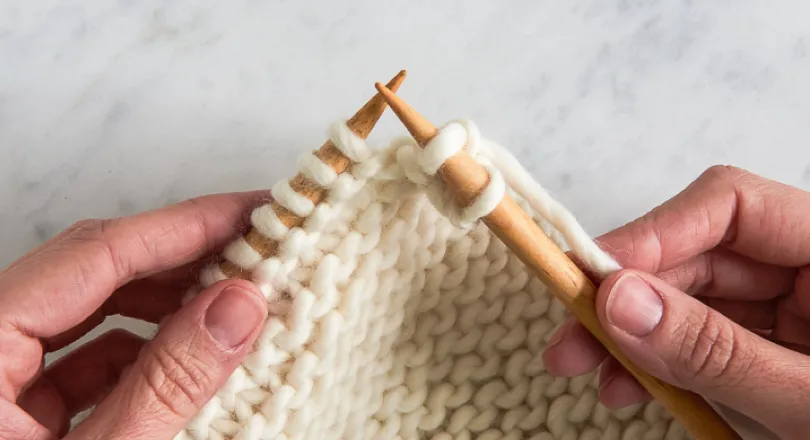
Sl1, k2tog, psso
If this is the first time you've encountered "sl1, k2tog, psso" it might sound a bit mysterious! Here are step by step instructions for completing this step:

Step 1: Sl 1
Whenever you encounter "sl 1", it means to slip one stitch as if to purl. Insert needle into stitch as if to purl and slip it to the right needle without knitting it.

Step 2: K2tog
Knit the next two stitches together.

Step 3: psso
"Psso" stands for "pass slipped stitch over". For this step insert your left needle into the stitch that you slipped and pass it over the k2tog and off of the right hand needle as you would when binding off.


purl bee
Reader Comments (51)
I added the pattern to Ravelry.
Hi James,
the pattern repeat is definitely 10+1.
This is really lovely - I am adding it to my ravelry queue too. :-) Thanks!
its to make the lace the same on both ends. I don't know that you really can knit this lace "backwards" but if you try it and it works we sure want to hear about it!
the first row ends 2 stitches short of a full repeat, is that what you're referring to? If not, let me know and I'll be happy to help you out further! Joelle
You're welcome! Note that rows 4 and 8 also have slight variation at the end of the last repeat too.
Good luck!
Joelle
Thanks!!!
Thanks for your help - the finished product looks so wonderful!
Abby
Are you still having the problem you described above? The pattern is definitely correct as written so something is happening in your knitting. Its hard to know what the problem is though since we can't watch you do it.
Here is a description of how to work the first knit row:
First you knit 3 stitches, then you knit 2 stitches together, wrap yarn around needle, knit 1 stitch, wrap yarn around needle, slip, slip knit (left slanting decrease), then knit 5 stitches, then repeat from knit 2 together.
If you're not ending up with enough stitches I wonder if you're repeating from the k3 at the beginning of the row?
Please let me know if this doesn't help clear up the problem!
Joelle
Yes, cast on a multiple of 10+1, try 31 or 41 and just follow the rest of the pattern as written. Keep in mind that this pattern curls in so if you make it 31 it might be quite narrow!
Good luck!
Thanks!
You should have 61 stitches after the 3rd row.
it sounds like you are doing an extra knit stitch between the yarn-overs. There are two solutions, one is to pull it out and start over and the other is to decide that you love it with the two knit stitches and continue. Let me know if you have questions about doing the yarn over! --Joelle
I'm still not getting it. I don't see how there can be 16 stitches in Row 2 (not counting the yo's because you're creating those stitches) when the pattern says it's a multiple of 10+1. In your answer to Terri above, you say that row "ends 2 stitches short of a full repeat" (so why doesn't it say that in the instructions?) which I've just never seen in a knitting pattern before. Does it mean that your last leaf at the right edge of the scarf is just squashed if there aren't full repeats? I've been trying some other laces form my various knitting books and I'm not finding any of them that don't have a full repeat. arg.
thanks!
Abby
As far as the short stitches in a few of the rows, it does say it in the pattern in rows 2, 4, and 8. You see this in patterns that have a motif that is a diamond shape like this one. If you look in the detail photo above you can see how the scarf undulates along the edge, and the pattern is written in such a way that it creates that edge (rather than squashing the motif).
For your other question, regarding the amount of stitches, I promise you that there are just the right amount of stitches if you cast on 61, or another multiple of 10+1. If you look at it the way I describe below maybe it will help?
Here is the row you seem to be having trouble with:
K3, *k2tog, yo, k1, yo, ssk, k5 repeat from *, end last repeat k3.
Lets say you have 21 stitches and you work them as follows
3 stitches for k3 (2 stitches for k2 tog, 0 stitches for yo, one stitch for k1, 0 stitches for yo, 2 stitches for ssk, 5 stitches for knit 5), repeat the stitches within the parenthesis but end the last knit five with knit 3 instead, this equals:
3+2+1+2+5+2+1+2+3= 21
Please let me know if this helps, or not. I really want to help you get this right!
Joelle
Yes, 31 or 41 will work. Just keep in mind that the scarf will curl up when its done so it will be narrower than it looks on the needles.
Good Luck!
Not at this time! It would be beautiful at the bottom of sleeves though. Let us know if you decide to make one or find something like it!
I haven't gotten to the stockinette portion yet, and I haven't decided what I'm going to do. I was either going to--
1. Just follow the pattern...but how do I make the edges neat? Or
2. I was thinking of adding a border to the stockinette portion to prevent the scarf from curling. Do you have any recommendations to which stitch? Garter? Seed stitch? And how wide should I make the border?
Thanks!
The edges curl in so its not such a big deal if they aren't neat, but if you'd like you can slip the first stitch of every row to make it tidier. The lace portion is also stockinette so it curls too, though not as much. Either garter or seed will work so it is really just a matter of what look you prefer.
Thanks for posting this!
i have repeated steps 1-16 two times but i don't know what I'm doing wrong. For some reason my pattern doesnt come up like yours. My is pretty flat. PLEASE HELP ME :(
We are happy to help out, but need just a bit more information from you. Can you tell us if you are ending up with the right amount of stitches at the end of each row? What do you mean by "coming up flat"? Are you seeing the leaf pattern emerge? etc. Any info you can give us will be a big help!
Well the problem is that I do see the leaf pattern but the problem is that its all at the same level. The leaves are not higher up then the rest so when i look at it, its all the same. I'm pretty sure I have the right amout of stiches on each row.
I'm already done with the first 16 rows 6x and it looks great. I'm starting on the stockinette portion. I'm wondering if anyone tried to just follow the pattern through without having to sew two parts together. Would it be too different ?
Thanks,
Cristina
The reason it's made in two parts is so that the lace portion will be the same on both ends. If you work the lace from the top down the cast off will be the opposite shape of the cast on, but it might be nice that way, you never know!
I'll try it and I'll post a pic and see if it looks very different.
Again, Thank you!!
Cristina
Here is row 8, I'll try to explain it in more detail:
Row 8: K2tog, *k3, yo, k1, yo, k3, sl 1, k2tog, psso; repeat from * to last 9 stitches, end last repeat k3, yo, k1, yo, k3, ssk.
Knit 2 together, knit three stitches, yarn over, knit one stitch, yarn over, knit 3 stitches, slip one stitch, knit two together, pass the slipped stitch over the knit two together, repeat until you have 9 stitches remaining, end last repeat knit 3 stitches, yarn over, knit one stitch, yarn over, knit 3 stitches, slip-slip-knit.
I'm not sure why you would end up with an extra stitch unless you are doing something funny when you yarn-over (sometimes knitters thing a yarn over includes knitting a stitch but it doesn't) or if you aren't passing the slipped stitch over on the last part of the pattern. Let me know if you need more help!
Joelle
We do understand what you are saying! It sounds like you are describing a "provisional cast on". The provisional cast on is a great technique, but it isn't appropriate for this pattern because on this scarf you are joining the two pieces at the end of the knitting rather than at the cast on. Hope this clarifies it for you, but if not be sure to let us know.