Whit's Knits: Baby Bonnet

Easter is about the only time of year you might hear talk of bonnets, but for babies, bonnets are a fact of life! Snuggly and warm, bonnets embrace the delicate contours of a baby's head, while under-the-chin ties prevent the famous "stroller fling".

The engineering of these little Baby Bonnets was inspired by the small miracle in sock knitting that is "turning the heel". I thought it would be neat to isolate that magical moment, using it to structure the planes of a bonnet. First from the front peak to the mid-crown and then across the entire back, you essentially "turn the heel", but somehow instead of a sock, you end up with a sweet Baby Bonnet!

Thinking about tender babies, I turned to one of Purl Soho's most exquisite yarns, Anzula's For Better Or Worsted. A beautiful blend of superwash merino, cashmere and nylon, it is soft, sumptuous, and stunningly hand dyed. Just right for babies!

I hope you enjoy knitting this little one-skein project. It's a bit surprising and a whole lot of fun!
The Materials
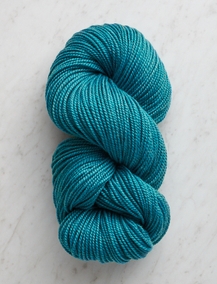
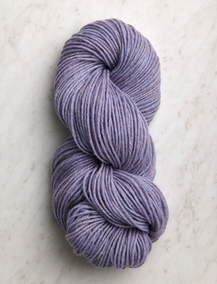
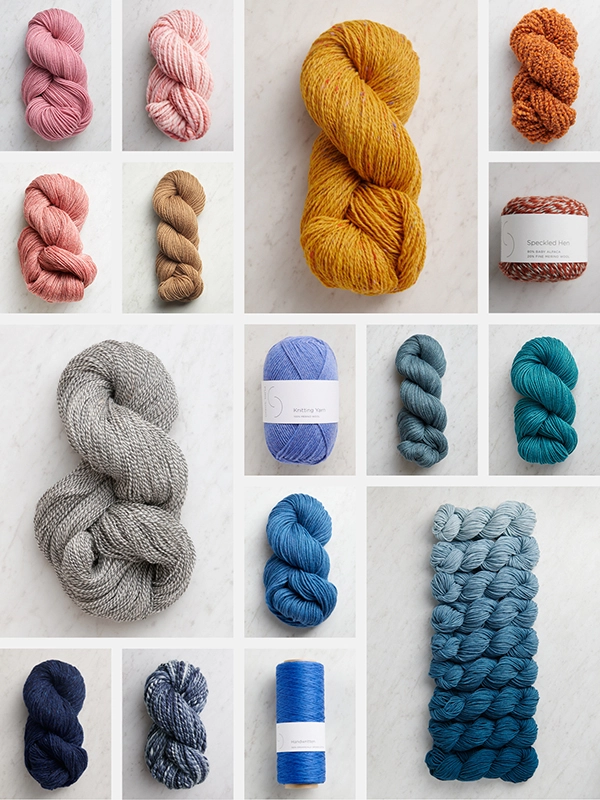
- 1 skein of Anzula's For Better or Worsted, 80% Superwash Merino, 10% Cashmere, and 10% Nylon. These colors, from the left, are Au Natural, Clay, and Avocado. (One skein will make two Baby Bonnets with only about 5 yards to spare, so be sure of your gauge!)
- A US #6 circular needle. Any length between 16 and 40 inches is okay, but I would recommend 20 or 24 inches.
- Two US #5 double pointed needles.
The Pattern
Gauge
5 1/2 stitches = 1 inch in stockinette stitch
Finished Size
To fit a 9 month to 18 month old. (Baby Eleanor, pictured in our photos, is 7 months old and a bit on the small side. The Baby Bonnet is perhaps a little big on her...)
Finshed Measurements
From cheek to cheek: 14 inches
From bottom of side to middle of the crown: 6 1/2 inches
From forehead to back of crown: 5 inches
The Crown
Cast 46 stitches onto the circular needle.
Row 1 (right side): K25, slip slip knit (ssk), k1, turn the work so the wrong side is facing you. (27 stitches on the left needle and 18 stitches on the right needle)
Row 2 (wrong side): Slip 1 purlwise, p5, p2tog, p1, turn the work so the right side is facing you. (26 stitches on the left needle and 18 stitches on the right needle)
Row 3: Slip 1 purlwise, knit to 1 stitch before the gap (see below), ssk (with the stitch before the gap and the stitch after the gap), k1, turn.
Here's the so-called "gap":

Row 4: Slip 1 purlwise, purl to 1 stitch before the gap, p2tog, p1, turn.
Repeat Rows 3 and 4 until all the stitches have been worked, purling instead of slipping the first stitch of the last row. (26 stitches remain)

Next Row (right side): Knit.
Next Row (wrong side): Purl.
Repeat the last 2 rows seven more times.
Bind off loosely, leaving the last stitch on the needle.

The Right Side

With the right side facing you, pick up 14 stitches along the side of the Crown from Point A to B (15 stitches on needle). Place a marker. Pick up 18 stitches from Point B to C. (33 stitches total)

Row 1 (wrong side): P2tog, purl to end. (1 stitch decreased)
Row 2: Knit to marker, make 1 left, knit to last 2 stitches, k2tog.
Repeat Rows 1 and 2 two more times, removing the marker on the last row. (30 stitches)
Next Row (wrong side): Repeat Row 1. (29 stitches)
Next Row: Knit to last 2 stitches, k2tog. (28 stitches)
Next Row: Purl.
Next Row: Knit to last 2 stitches, k2tog. (1 stitch decreased)
Repeat the last 2 rows three more times. (24 sttiches)
Next Row (wrong side): Purl.
Next Row: Knit.
Repeat the last 2 rows four more times.
Next Row (wrong side): Purl.
Next Row: Ssk, knit to end. (1 stitch decreased)
Repeat the last 2 rows two more times. (21 stitches)
Next Row (wrong side): Purl.
Bind off loosely. Cut the yarn and pull it through the remaining stitch.

The Left Side

With the right side facing you, join new yarn and pick up 18 stitches along the other side of the Crown from Point A to B. Place a marker. Pick up 15 stitches from Point B to C. (33 stitches total)

Row 1 (wrong side): Purl to last 2 stitches, p2tog through the back loop (p2tog tbl). (1 stitch decreased)
Row 2: Ssk, knit to marker, slip marker, make 1 right, knit to end.
Repeat Rows 1 and 2 two more times, removing the marker on the last row. (30 stitches)
Next Row (wrong side): Repeat Row 1. (29 stitches)
Next Row: Ssk, knit to end. (28 stitches)
Next Row: Purl.
Next Row: Ssk, knit to end. (1 stitch decreased)
Repeat the last 2 rows three more times. (24 sttiches)
Next Row (wrong side): Purl.
Next Row: Knit.
Repeat the last 2 rows four more times.
Next Row (wrong side): Purl.
Next Row: Knit to last 2 stitches, k2tog. (1 stitch decreased)
Repeat the last 2 rows two more times. (21 stitches)
Next Row (wrong side): Purl.
Bind off loosely, leaving the last stitch on the needle.

The Back
With the right side facing you, pick up 29 stitches along the back of the Left Side (30 stitches on needle), pick up 24 stitches along the back of the Crown, and pick up 30 stitches along the back of the Right Side. (84 stitches total)

Row 1 (wrong side): P44, p2tog , p1, turn the work so the right side is facing you. (46 stitches on the left needle and 37 stitches on the right needle)
Row 2 (right side): Slip 1 purlwise, k5, ssk, k1, turn the work so the wrong side is facing you. (45 stitches on the left needle and 37 stitches on the right needle)
Row 3: Slip 1 purlwise, purl to 1 stitch before the gap, p2tog (with the stitch before the gap and the stitch after the gap), p1, turn.
Row 4: Slip 1 purlwise, knit to 1 stitch before the gap, ssk, k1, turn.
Repeat Rows 3 and 4 until 7 stitches remain on each end of the needle after the gaps. (52 stitches total)

Next Row (wrong side): Slip 1 purlwise, p13, p2tog tbl, p6, p2tog, purl to the 1 stitch before the gap, p2tog, p1, turn.
Next Row: Slip 1 purlwise, knit to 1 stitch before the gap, ssk, k1, turn.
Repeat the last 2 rows two more times. (1 stitch on each end after the gaps, 40 stitches total)
Next Row (wrong side): Slip 1 purlwise, purl to 1 stitch before the gap, p2tog. (39 stitches)
Next Row: Bind off loosely to last 2 stitches, ssk, and bind off the final stitch.
Cut the yarn and pull it through the last stitch.

The Attached I-Cord
Cast 3 stitches onto a US #5 double pointed needle.
Knit an I-cord that is 9 1/2 inches unstretched and 12 inches stretched.

With the right side facing you and beginning at Point A, knit an Attached I-cord. Between Points A and B pick up 32 stitches.

Between Points B and C pick up 7 stitches. And between Points C and D pick up 32 stitches.
Continue to knit an (unattached) I-cord to match the length of the first one (9 1/2 inches unstretched).
Bind off. Cut the yarn and pull it through the last stitch.

Now, with a double pointed needle, pick up 2 stitches from the unattached I-cord at Point D. Then pick up 1 stitch from the bound off edge of the Left Side.

As you now knit the Attached I-cord, pick up 18 stitches along the Left Side. Pick up 35 stitches along the Back, and pick up 18 stitches along the Right Side.
Bind off. Cut the yarn and pull it through the last stitch.
Use the tail to sew the bound off end of this I-cord to the first I-cord you made.

Weave in the ends and gently block your wee Baby Bonnet!


March 25, 2012
Reader Comments (19)
The photo will show the link of this original post clearly embedded on it.
If you don't like, I'll revoke the post on my personal blog surely...
You do knit the first 9 1/2 inches as a separate I-cord, but then you continue to knit it as an Attached I-cord which is a technique that simultaneously knits the I-cord while attaching it to the bonnet. We have an Attached I-cord tutorial right here: http://www.purlbee.com/attached-i-cord-tutorial/2008/1/23/attached-i-cord-tutorial.html .
If you find all this technique a little overwhelming, you could also just knit an appropriate length of I-cord that you sew onto the bonnet at the end.
Thanks for your question and for knitting this little bonnet!
Whitney
This is a pretty complicated pattern to alter. It would involve extending all of the widths and lengths and adjusting the number of stitches you pick up along the way. Otherwise, my best suggestion would be to knit at a larger gauge (either this yarn looser or a bigger yarn).
Thanks for asking. I hope you know a slightly smaller baby who will appreciate your efforts so far!
Whitney
Thank you for the lovely pattern - as always, I am inspired and enjoying.
Thanks for the sweet and fun pattern!
Yes, I do mean to pick up and knit. I never know how to least confuse people with picking up terminology, since so many different understandings of the process have developed!
Thank you for your question and for making this Bonnet, one of my favorites!
Whitney
Thanks,
Anne
The "gap" is the place where you turned the work two rows before. Turning the work should have created a discernible and fairly obvious extra-wide space between two stitches. For Row 3, the gap is after the 8th stitch, so you'll be working the first 7 stitches.
I hope this helps... I'm sorry for the confusion! The "gap" is commonly referred to in sock knitting and it didn't occur to me to clarify!
Thanks so much for asking and please let me know if you're still stuck!
Whitney
And thanks- it became much clearer after you said that. Turned out great!
Anne
I use uk size needles what size would that be if
Your using us size 6 needles?
Thanks
It is a UK size 8. Here is a link to a conversion chart in case you have any more questions: http://knitting.about.com/od/toolsandsupplies/a/needlesize.htm
Thanks so much for writing in!
Molly
It's the first time I'm making an attached i-cord. When I did it with the right side facing me the "old edge" came out of the i-cord. It looked a bit messy. But when I tried knitting the attached i-cord with the wrong side facing it turned out much better. Do you have a clue why?
Huh, very interesting. I'm not sure why that is happening... Are you slipping the last stitch of the I-cord and then making a yarn over? This technique effectively hides the "old edge." Otherwise, I can't really imagine why working with the wrong side facing is turning out better for you. I would recommend checking out our Attached I-Cord Tutorial, if you haven't already: http://www.purlbee.com/attached-i-cord-tutorial/2008/1/23/attached-i-cord-tutorial.html
I hope one of these suggestions sorts out this perplexing question for you! Let us know and thanks for asking!
Whitney