Whit's Knits: Baby Jumper

When there's a baby in the picture, knitters have a hard time sitting idle. Our fingers twitch until we've outfitted that little bundle in our finest efforts. So when Molly's baby Guadalupe joined the Purl Bee family, that was my cue to get knitting!

I designed this Baby Jumper to appease little Lupe's budding sense of style but also her mother's legendary concern for practicality! Loose and soft and comfy, this simple dress is easy to slip over a squirmy baby's head and really works for the longhaul, first as a jumper, then as a tunic, and even later as a shirt. Plus, it's machine washable. Even Molly has to approve!

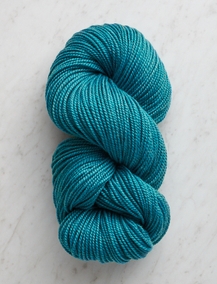
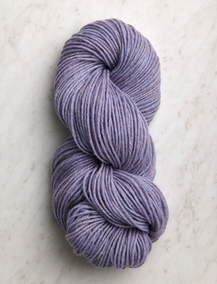
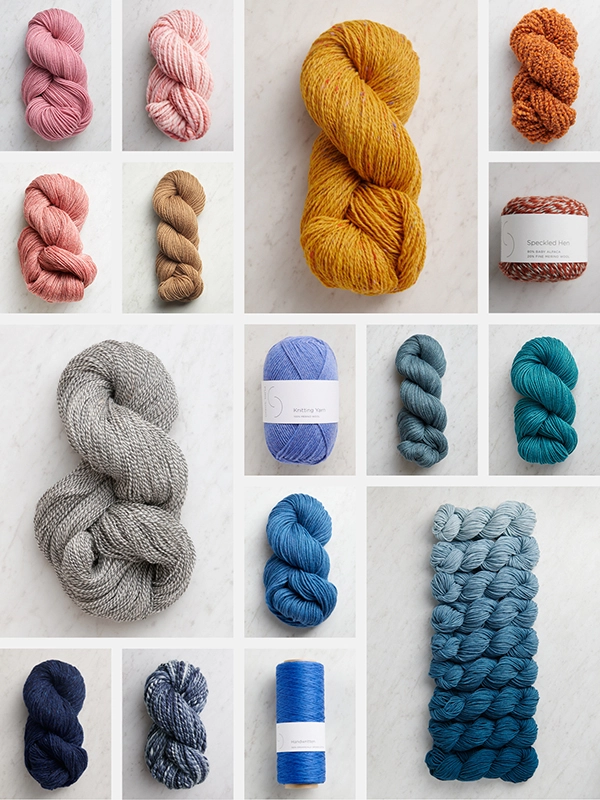
And since every hand knit baby gift has heirloom potential, I knit this one up in Anzula's very special Sebastian yarn. Sebastian combines superwash merino with sea cell, a newfangled seaweed-cellulose fiber that offers durability, drape and a very pretty soft shine!
PS Want to catch a glimpse of sweet Lupe in her Baby Jumper? Click here to see her on Instagram!
The Materials
- Anzula's Sebastian, 70% Superwash Merino and 30% Sea Cell.
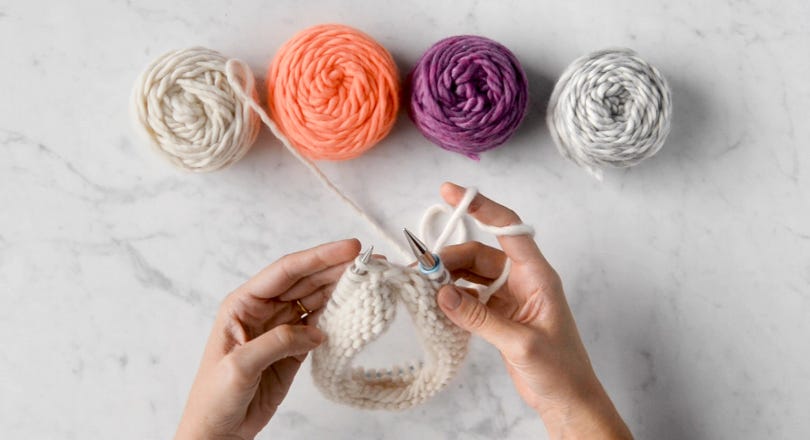
- Main Color: 1 (2, 2) skeins. I used the color Seaside (above, right).
- Contrast Color: 1 (1, 1) skein. I used the color Hyacinth (above, left).
- A US #2, 24-inch circular needle
- A US #3, 24-inch circular needle
- Two US #2 double pointed needles
- A size B (2.5 mm) crochet hook
- A 3/8-inch button. Purl Soho's Small Mother of Pearl Buttons would be a good choice!
The Pattern
Gauge
7 3/4 stitches = 1 inch in stockinette stitch with larger needle
Finished Sizes
Small, Medium, Large: 6-9 (9-12, 12-18) months
Circumference around bottom hem: 28 1/2 (29 3/4, 31) inches
Circumference around top band: 18 (18 3/4, 19 1/2) inches
Length from underarm (top of band) to bottom hem: 12 (13 1/4, 14 1/2) inches
Length from shoulder to bottom hem: 15 1/4 inches (16 3/4, 18 1/4) (adjustable)
Neck opening: 4 1/2 (4 3/4, 5) inches
NOTE: The photos that accompany this pattern are of the Small size.
Begin
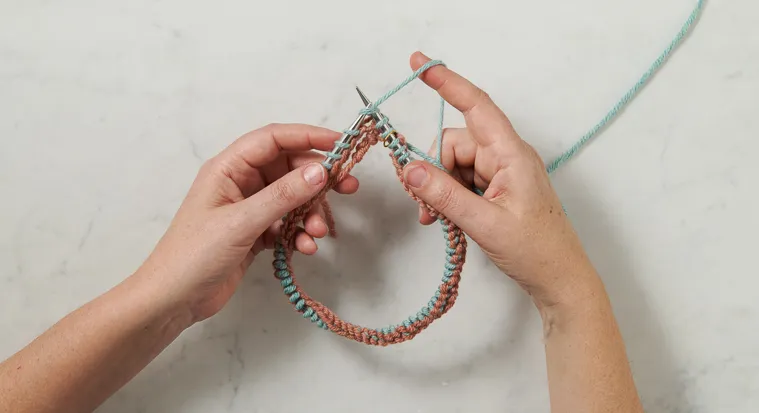
With the US #2 circular needle and the Main Color (MC), cast on 221 (231, 241) stitches.
Place marker and join for working in the round, being careful to not twist the stitches.
Round 1: Purl.
Round 2: Knit.
Rounds 3 and 4: Repeat Rounds 1 and 2.
Round 5: Purl.
Change to US #3 circular needle and knit every round until piece measures 11 (12, 13) inches from cast on edge.
Cut yarn.
The Band
Change to US #2 circular needle and the Contrast Color (CC), leaving a 12-inch tail.
Round 1: *K1, (ssk, k2tog), repeat from * to last stitch, k1. 133 (139, 145) stitches
Now work back and forth in rows, turning the work at the end of each row.
Row 1 (wrong side): With the purl side facing you, knit.
Row 2 (right side): Knit.
Row 3: Purl.
Repeat Rows 2 and 3 four (five, six) more times.**
Repeat Row 2.
Repeat from Row 1 to ** one time.

Finishing the Band
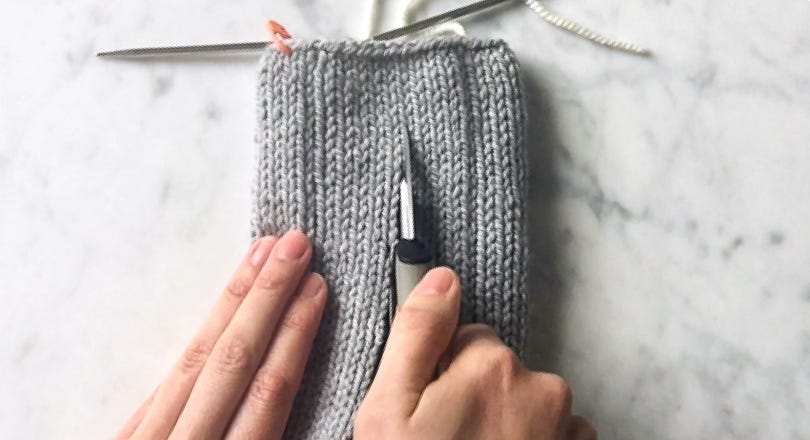
Fold the band over so the wrong sides are facing each other and...
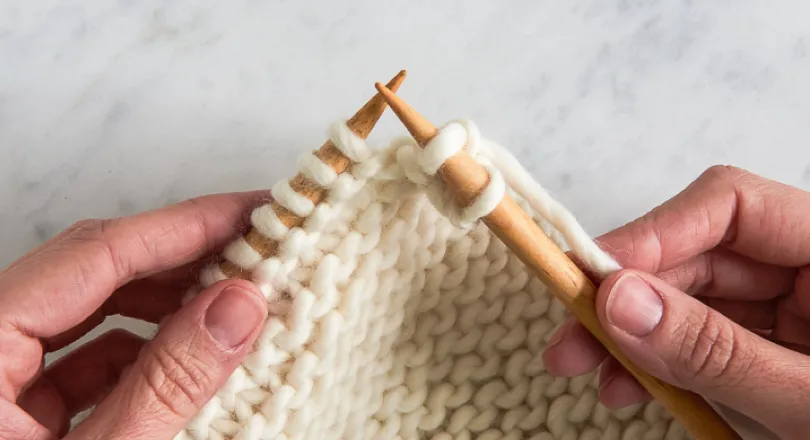
1. With the right needle, pick up the purl bump from the color change round that is directly in line with the first stitch on the left needle.

2. Slip the purl bump onto the left needle.

3. Knit two together (the purl bump and the first "regular" stitch).

(At the beginning of the row, repeat these three steps one more time so that you are able to do the next step.)
4. Slip the second stitch on the right needle over the first (just like binding off).

Repeat these 4 steps all the way to the end of the band. (Tip: Check frequently that the stitch you're picking up is still in line with the first stitch on the left needle, otherwise the band will start to skew.)
Cut the yarn, leaving a 12-inch tail.

With a size B crochet hook, use the CC tails to crochet closed the ends of the bands. Here's how:
Insert the hook through the edge of both layers of fabric.

Pull a stitch through and chain 1. On the right-hand side, make 8 (9, 10) slip stitches along the edge of the band, inserting the hook through both layers of fabric each time. Cut the yarn and pull it through the remaining stitch.
On the left-hand side, create a small buttonhole. Here's how: make 6 (7, 8) slip stitches to 1/4 inch from the top of the band, chain 6, reinsert the hook right next to the chains and make 2 slip stitches to the end. Cut the yarn and pull it through the remaining stitch.

Weave in the ends, using the MC tail to close the gap at the base of the band.
Right Strap
With the right side facing you and using a US #2 double pointed needle and the CC, begin 3 1/4 (3 1/2, 3 3/4) inches to the right of the back split...

... to pick up 8 (9, 10) stitches along the top of the band.

Row 1: [kfb] 8 (9, 10) times. 16 (18, 20) stitches
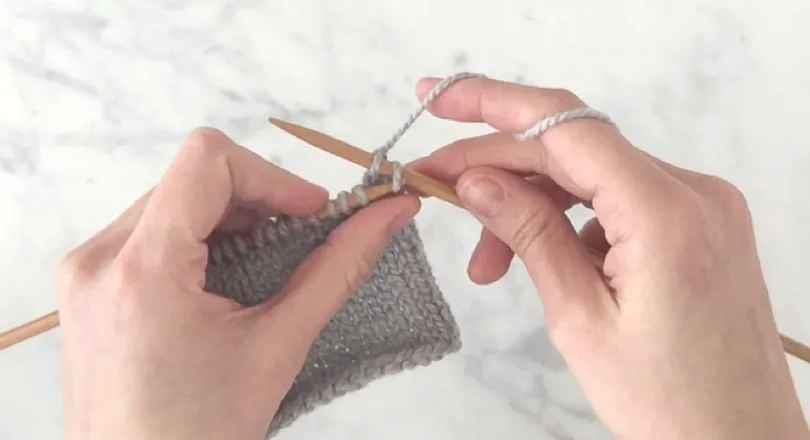
Row 2: Slip 1 knitwise through the back loop, *bring the yarn forward, slip 1 purlwise, bring the yarn back, knit 1, repeat from * to last stitch, purl 1. (For a photo tutorial of this row, visit our Double Knit Belt Project Journal here.)
Repeat Row 2 until strap measures 6 1/2 (7, 7 1/2) inches. (If the recipient of your jumper is on hand, take a measurement from an inch below her armpit, over the top of her shoulder and to the other side of her armpit. Knit the strap to this length minus an inch [because the strap will stretch with the weight of the finished jumper].)
Bind Off Row: [K2tog] 2 times, *pass the first stitch over the second stitch (like a normal bind off), k2tog, repeat from * until one stitch remains. Cut the yarn, leaving an 8-inch tail, and pull it through the remaining stitch.
Fold the dress in half at the back slit and mark the front center of the band.

Situate the bind off end of the strap (making sure it's not twisted!) so that its right edge is 2 1/4 (2 3/8, 2 1/2) inches left of the center front mark.

Using the bind off tail, sew the end of the strap to the top of the band. For a neat finish, sew under the band's top purl bump...

...then under the bottom half of the bind off stitch.

Left Strap
With the right side facing you and using a US #2 double pointed needle and the CC, begin 2 1/4 (2 3/8, 2 1/2) inches to the left of the back split...

... to pick up 8 (9, 10) stitches along the top of the band.
Work from Row 1 through the Bind Off Row of the Right Strap instructions, above.
Then situate the bind off end of the strap (making sure, again, that it's not twisted) so that its left edge is 2 1/4 (2 3/8, 2 1/2) inches left of the center front mark. Sew the strap's end to the top of the band.
Sew a button onto the band across from the buttonhole.
Weave in any remaining ends, gently block and you're done!


March 14, 2013
Reader Comments (8)
No, not really :). I just like the design detail, but the button could also come in handy if the tight gets a bit snug.
Thanks for asking!
Whitney
Besides, I'm from Germany, a knitting beginner ;) and have a difficulty in understanding the gauge. Why are there mentioned only stitches and no rows?
My question has to do with the number of stitches cast on. Tonight I started this project casting on the 231 stitches for the 9-12 jumper. As I completed the first five rows, I noticed that there seemed to be a lot of stitches on my needles, bunching and twisting. Worried about how big this Jumper was really going to be, I pulled it off of my circular needle. The knit was HUGE. Did I do something wrong? I quick grabbed my measuring tape and did some calculations.
My diameter was about 12 in, multiplying that by 3.14, the circumference almost 38 inches. So, the 231 stitches for me was nowhere near your calculations. I know how to gauge out my work, and I consider myself a very tight knitter (so far as a novice), and I have the right needle sizes but I didn't know why my work was so much bigger. I did the math, your pattern reads 29 3/4 inches for the Jumper I want to make, which means I needed around a 9 inch diameter to get a circumference of 29 and some change. Which, for me, was about 171 stitches. Is that normal? Am I reading something wrong? Do I just continue on with less stitches cast on?
Once again, thank you for such awesome patterns! And for your time reading this. I hope I made sense...I just would really like to learn this new craft and want to make sure that I am successful!
We don't usually include the row gauge because it is proportionate to the stitch gauge. Also, the stitch gauge is often much more important for getting the size right, since so frequently a pattern tells you to knit a certain number of inches rather than a certain number of rows (or rounds).
Thanks for asking!
Whitney
One big problem with your situation is that measuring your knitting after just a few rounds (or even after just a few inches) is very misleading! It's always way bigger than the tube will actually be in the end.
If you have a firm grasp on making a swatch and measuring your gauge, and you did, in fact, find the needle that gets you to 7 3/4 stitches to the inch, then you should be all set! To review swatches and gauges, here is our Not Too Tight Tutorial: http://www.purlbee.com/not-too-tight-tutorial/
One technicality that you may want to explore is that if you knit your gauge swatch flat (i.e. knit 1 row, purl 1 row) it may not be entirely accurate because you may be a very loose or tight purler, and you don't actually purl for most of this pattern. To overcome this problem, check out our Swatching a Circular Gauge Tutorial right here: http://www.purlbee.com/swatching-circular-gauge/
I hope this information helps! Please let us know if you have any other questions and good luck with your knitting adventures!
Whitney