Laura's Loop: Bobble Sheep Pillow

I guess it isn't surprising that a knitter has an affinity for sheep. Obviously, some sort of kinship must exist with the animal whose wool provides daily enjoyment (and employment!). So as predictable as it may be, I will say it anyway... I love sheep. They are a funny creature with a neurotic voice and a body perfect for graphic adaptation.

A dear friend pointed out that it may be a bit snake-eating-its-own-tail, but anyway, I had to make one... I had to make a sheep, made out of sheep.


The Materials

All the yarn you'll need to make your own Bobble Sheep is in one place! Click right here for the Yarn to Complete the Bobble Sheep Pillow kit (needles and stuffing are not included).
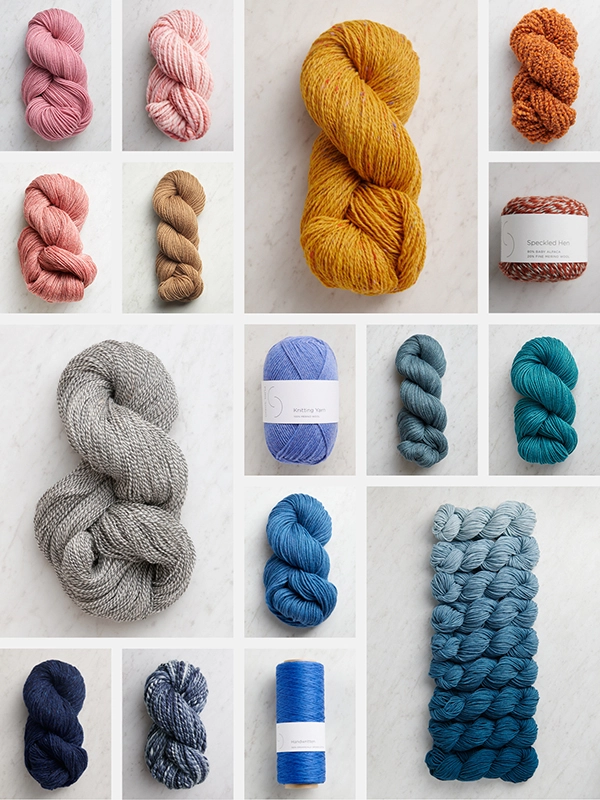
- Main Yarn: 4 skeins of Purl Soho's Super Soft Merino in the color Heirloom White.
- Contrast Yarn: 1 skein of Blue Sky's Sport Weight Alpaca in the color 509 Dark Gray.
- US #11, 16 or 24-inch circular needles
- A set of US #11 double pointed needles
- A set of US #3 double pointed needles
- 1 bag of stuffing
The Pattern
Gauge
3 stitches = 1 inch in garter stitch using Super Soft Merino on US #11 needles
7 stitches = 1 inch in stockinette stitch using Sport Weight Alpaca on US #3 needles
Finished Dimensions
19 inches from chest to tail
14 inches from top of back to bottom of belly
Pattern Notes
There are several different ways to make a bobble, this is a 5-stitch garter bobble. For a full-photo tutorial on how to make this particular bobble, please click here.
Make Bobble (MB): Knit into the next stitch, leaving it on the left needle, [(yarn over, knit 1) into same stitch] two times. Turn work (wrong side is facing you), k5, turn work (right side is facing you), k2tog and return stitch to left needle, slip remaining three stitches of bobble over the k2tog stitch, knit that stitch, returning it to the right needle.
Slip 1, k2tog, psso (or sk2p): This is a left-slanting double decrease. Slip 1 purlwise, knit 2 together, pass the slipped stitch over the knit stitch and off the needle.
Knit 3 together (or k3tog): This is a right-slanting double decrease. Insert right needle into next three stitches as if to knit. Knit all three stitches together as if they were one stitch.
Begin at the Belly

With the larger double pointed needles and the Main Yarn, use the Provisional Cast On method to cast on 46 stitches.
Place marker and join for working in the round being careful not to twist stitches.
Round 1: Knit.
Round 2: [P21, place a marker that is a different color than the end-of-the-round marker, k2] two times.
Round 3: Knit.
Round 4: [Purl to next marker, slip marker (sm), k2] two times.
Increasing to Shape the Body
NOTE: Change to circular needles when necessary.
(Increasing every round)
Round 5: [M1L, k2, *make bobble (MB), k3, repeat from * to 3 stitches before next marker, MB, k2, m1R, sm, k2] two times. (4 stitches increased)
Round 6: [M1L, purl to next marker, m1R, sm, k2] two times. (4 stitches increased)
Repeat Rounds 5 and 6 three more times. (78 stitches)
(Increasing every other round)
Round 7: [K2, *MB, k3, repeat from * to 3 stitches before next marker, MB, k2, sm, k2] two times.
Round 8: [M1L, purl to next marker, m1R, sm, k2] two times. (4 stitches increased)
Round 9: [K1, *MB, k3, repeat from * to 2 stitches before next marker, MB, k1, sm, k2] two times.
Round 10: Repeat Round 8.
Round 11: [*MB, k3, repeat from * to 1 stitch before next marker, MB, sm, k2] two times.
Round 12: Repeat Round 8.
Round 13: [K3, *MB, k3, repeat from * to 4 stitches before next marker, MB, k3, sm, k2] two times.
Round 14: Repeat Round 8. (94 stitches)
Continue Working Evenly
Round 15: [K2, *MB, k3, repeat from * to 3 stitches before next marker, MB, k2, sm, k2] two times.
Round 16: [Purl to next marker, sm, k2] two times.
Round 17: [*MB, k3, repeat from * to 1 stitch before next marker, MB, sm, k2] two times.
Round 18: Repeat Round 16.
Repeat Rounds 15-18 two more times.
Decreasing for the Neck and Tail
NOTE: Change to double pointed needles when necessary.
Round 19: K2, *MB, k3, repeat from * to 3 stitches before next marker, sk2p (see Pattern Notes above), sm, k2, k3tog (see Pattern Notes above), **k3, MB, repeat from ** to 2 stitches before next marker, k2, sm, k2. (90 stitches, 4 stitch decrease at head)
Round 20: K2tog, purl to 3 stitches before next marker, sk2p, sm, k2, k3tog, purl to 2 stitches before next marker, ssk, sm, k2. (6 stitches decreased: 2 at tail, 4 at head)
Round 21: K3, *MB, k3, repeat from * to 5 stitches before next marker, MB, k1, sk2p, sm, k2, k3tog, k1, **MB, k3, repeat from ** to 4 stitches before next marker, MB, k3, sm, k2. (80 stitches, 4 stitches decreased at head)
Round 22: Repeat Round 20. (74 stitches)
Round 23: *MB, k3, repeat from * to 3 stitches before next marker, MB, k2, sm, k4, **MB, k3, repeat from ** to 1 stitch before next marker, MB, sm, k2.
Round 24: [K2tog, purl to 2 stitches before next marker, ssk, sm, k2] two times. (4 stitches decreased: 2 at tail, 2 at head)
Round 25: K1, *MB, k3, repeat from * to next marker, sm, k5, **MB, k3, repeat from ** to 2 stitches before next marker, MB, k1, sm, k2.
Round 26: Repeat Round 24. (66 stitches)
Round 27: K2tog, *MB, k3, repeat from * to 1 stitch before next marker, MB, sm, k2, **MB, k3, repeat from ** to 3 stitches before next marker, MB, ssk, sm, k2. (64 stitches, 2 stitches decreased at tail)
Round 28: Repeat Round 24. (60 stitches)
Round 29: K2tog, *MB, k3, repeat from * to 2 stitches before next marker, MB, k1, sm, **k3, MB, repeat from ** to 2 stitches before next marker, ssk, sm, k2. (58 stitches, 2 stitches decreased at tail)
Round 30: Repeat Round 24. (54 stitches)
Round 31: K2tog, *MB, k3, repeat from * to 3 stitches before next marker, MB, k2, sm, k4, **MB, k3, repeat from ** to 3 stitches before next marker, MB, ssk, sm, k2. (52 stitches, 2 stitches decreased at tail)
Round 32: Repeat Round 24. (48 stitches)
Round 33: K2tog, *MB, k3, repeat from * to next marker, sm, k5, **MB, k3, repeat from ** to 3 stitches before next marker, MB, ssk, sm, k2. (46 stitches, 2 stitches decreased at tail)
Remove beginning of round marker and slip the last stitch of the last round onto the left needle.
Cut yarn, leaving an approximately 35-inch tail.
Divide the stitches in half, sliding 23 stitches to each end of the circular needle or arranging them onto two double pointed needles.
Holding the needles parallel to each other, use the Kitchener Stitch to graft together the two sides of the Bobble Sheep's back.
Weave in the ends.

NOTE: You will notice in the pictures that I next stuffed the Sheep and used the Kitchener Stitch once again to graft together the two sides of the Belly. It would be easier, however, to make the Face, the Ears and the Tail before stuffing the Sheep and grafting its Belly.
Make the Head

Orienting the Sheep right side up and pretending for a moment that it is a clock, the Neck is the slanted area from about 9:30 to 11:30. Using the Contrast Yarn and the smaller double pointed needles, pick up 92 stitches around the stripe of stockinette stitches at the Neck.
To do this, start at the left bottom of the neck, pick up 3 stitches in each of the next fifteen stitches along the left side of the neck, two stitches along the top, rotate the sheep and pick up 3 stitches in each of the fifteen stitches along the right side. (To pick up 3 stitches in one stitch, pick up and knit one stitch, yarn over, bring the needle back into the same stitch and knit to pick up another stitch.)
Place a marker and join for working in the round.
Set-up Round: K16, place a different color marker, k30, place a different color marker, k30, place a different color marker, knit to end of round.
Round 1: K1, m1L, knit to first marker, sm, k2tog, knit to 2 stitches before next marker, ssk, sm, k2tog, knit to 2 stitches before next marker, ssk, sm, knit to last stitch, m1R, k1. (2 stitches decreased)
Round 2: Knit to first marker, sm, k2tog, knit to two before third marker, ssk, sm, knit to end of round. (2 stitches decreased)
Repeat Rounds 1 and 2 five more times. (68 stitches)
Round 3: Knit to first marker, sm, k2tog, knit to 2 stitches before next marker, ssk, sm, k2tog, knit to 2 stitches before next marker, ssk, sm, knit to end of round. (4 stitches decreased)
Repeat Rounds 2 and 3. (58 stitches)
Repeat Round 2 one more time. (56 stitches)
Round 4: K2tog, knit to first marker, sm, k2tog, knit to 2 stitches before next marker, ssk, sm, k2tog, knit to 2 stitches before next marker, ssk, sm, knit to last 2 stitches, ssk. (6 stitches decreased)
Repeat Round 4, removing first and third marker. (44 stitches)
Round 5: K2tog, knit to 2 stitches before next marker, ssk, sm, k2tog, knit to last 2 stitches, ssk. (4 stitches decreased)
Repeat Round 5 two more times. (32 stitches)

Cut yarn leaving an approximately 15-inch tail.
Divide stitches in half, placing the first 16 stitches on the first double pointed needle and the second 16 stitches on the second double pointed needle. Use Kitchener Stitch to graft together the two sides of the Head.
Weave in the ends.
Make the Right Ear

Using the Contrast Yarn and the smaller double pointed needles, pick up 18 stitches for the Right Ear (as you face the Sheep).
To do this, count four stitches down from the top, right side of the Sheep's Head (right above a bobble). Pick up 3 stitches in this stitch, and in the next two stitches above it (9 stitches so far). Then rotate the sheep and pick up 3 stitches in each of the stitches directly across from those you just picked up, working back towards thes tarting point. (18 stitches)

**Place marker and join for working in the round.
Knit 4 rounds. At the end of the fourth round, remove marker and turn work. You will no longer knit in the round, but back and forth in rows, turning the work at the end of each row.
Row 1: Purl.
Row 2: Knit.
Repeat Rows 1 and 2.
Repeat Row 1.
Next Row: K1, ssk, knit to last 3 stitches, k2tog, k1. (2 stitches decreased)
Next Row: Purl.
Repeat last two rows 6 more times. (4 stitches)
Next Row: Ssk, k2tog. (2 stitches)
Bind off purlwise.
Weave in your ends.
Make the Left Ear
Making the Left Ear is very similar to making the Right. The only difference is where you pick up the stitches.
Find the bobble across from the bobble you used as the starting point for the Right Ear. Pick up 3 stitches in each of the next three stitches above that bobble. Rotate the sheep and pick up 3 stitches in each of the next three stitches along the side of the Sheep's Head, working back towards the starting point. (18 stitches)
Repeat steps under Make the Right Ear starting at **.

Make the Tail

With Main Yarn and the larger double pointed needles, pick up 12 stitches as shown above. Facing the Sheep's rear, locate the left side of the left stitch that is 5 stitches down from the end of the Sheep's back. Starting there, pick up 5 stitches up the left side, 2 stitches along the ridge of the Sheep's back and 5 stitches down the right side the Sheep's rear. (12 stitches)
Knit 4 rows.
Next Row: Bind off 1, knit to end. (1 stitch decreased)
Repeat last row 3 more times. (8 stitches)
Bind off.
Make the Legs

NOTE: Before you make the Legs, stuff the Sheep loosely, then pick up the stitches from the Provisional Cast On, divide them in half and use the Kitchener Stitch to graft the Belly closed.
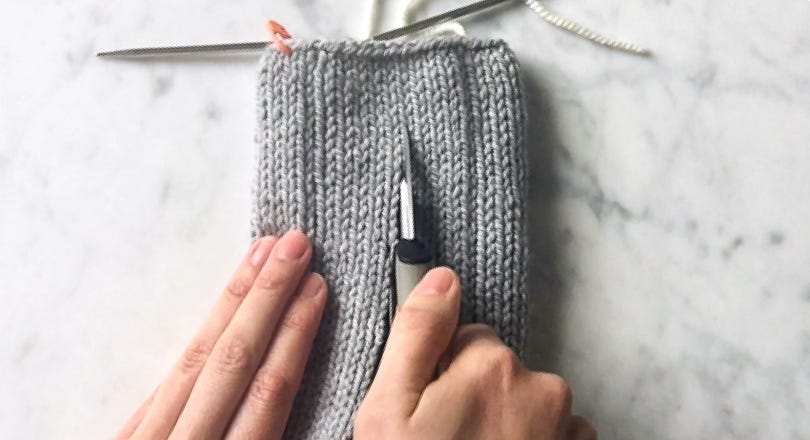
Using the Contrast Yarn and the smaller double pointed needles, pick up 26 stitches at one end of the Sheep's Belly, as shown above. To do this, pick up 3 stitches in each of the 4 stitches along one side of the Belly (12 stitches), pick up 1 stitch along the center of the Belly, rotate the sheep and pick up 12 stitches along the other side of the Belly and one last stitch along the center. (26 stitches)
Place marker and join for working in the round.
Round 1: [K12, p1] two times.
Repeat Round 1 until Leg measures 4 inches from the pick up round.
Next Round: [K11, ssk] two times. (24 stitches)
Cut yarn, leaving a 10-inch tail.
Divide stitches in half, placing the first 12 stitches on one double pointed needle and the second 12 stitches on a second double pointed needle. Use Kitchener Stitch to graft together the two sides of the Leg.

Make a second Leg at the other end of the Sheep's Belly.
Weave in your ends and you are all finished with your Bobble Sheep!


March 3, 2013
Reader Comments (55)
We have a Ravelry page that you can see here: http://www.ravelry.com/designers/purl-soho
Thanks so much for writing in!
Molly
http://www.ravelry.com/patterns/library/bobble-sheep-pillow
Laura
We don't have plans to make a crocheted version of this pattern, but thank you so much for the suggestion.
If you check out the comments from the front page of this story a reader named Ina had a suggestion for a bobbled crochet stitch pattern from ravelry: http://purlbee.squarespace.com/the-purl-bee/2013/3/3/lauras-loop-bobble-sheep-pillow.html#comments
Thank you for writing in!
Molly
This sheep is great!
Please can I use a picture or two from this along with a link on my little blog?
Thanks
You can use a photo if you link directly back to the story for the instructions.
Thank you for asking!
Molly
Thank you so much for writing in! Yes, the asterisk is in the wrong place. It should be [K3, *MB, k3,,,"
I have corrected the pattern.
Thank you again!
Laura
Those two following paragraphs are explanations of the knitting abbreviations SK2P and K3tog, respectively. These abbreviations are used in the pattern.
Let me know if you have any other questions.
Laura
All the best.
Steffilie
I'm in the midst of knitting my sheep but I can't find where you explain what m1l and m1r mean. What is this shorthand for?
I wish your patterns were easier to print out. I copied and pasted this into another program, but it would have been 50 pages!
We know this is a problem but unfortunately right now there isn't a super simple way to print them. We suggest that you copy and past the text and photos into a Word or Text doc and then print from there.
Thank you!
Molly
We don't sell any of our finished items. If you'd like to find a custom knitter to knit it for you you can call our shop at 212-420-8796 and they might be able to give you some names.
Thank you!
Molly
Bobbling right along
I am at round 17 and the pattern may have an error
Round 17. [*MB, k3 , repeat from * to 1 stitch before next marker, MB, k2, sm, k2]
2 times. If I knit to one stitch before next marker MB there is not 2 stitches to k2 because I am already at the marker.
Any clarifications will be helpful. This round is repeated 3 times. I don't want it to throw off my future rounds.
Thank you
Mary e Andrews
You are correct. Round 17 had a typo!
it was:
[*MB, k3 , repeat from * to 1 stitch before next marker, MB, k2, sm, k2]
it should be (and now is):
[*MB, k3 , repeat from * to 1 stitch before next marker, MB, sm, k2]
eliminating that k2 after the MB towards the end of the line.
Thank you so much for bringing this to our attention.
Please let us know how you find the rest of the pattern.
Thanks again,
Laura
Please see my response to Mary E Andrews above, regarding Round 17.
Thank you for taking the time to write in.
Laura
Sorry about that. I forgot to make those abbreviations hyperlinks (words that when clicked on they will take you to another page, explaining them) Here is a link to a tutorial for that abbreviation:
http://purlbee.squarespace.com/make-1-right-left-tutorial/
Please let me know if you have any other questions.
Laura
Thank you for taking the time to write in. I have corrected the typo.
Much appreciated.
Laura
Thank you so much for taking the time to write in.
I cannot find an error in Round 23.
You (bobble and k3) up to the last three stitches, bobble again, k2 slip the marker, k2 (for those knits between the bobble sections, "2s" you called them) then k2 more for the beginning of the back bobble sections (this reads k4 in the pattern), then you go on to (bobble and k3) until nearly the end and then one more bobble before the next "2s" (as you called them) that divide the front and back.
I think maybe you were knitting 2 to end the front bobble section, knitting 2 for the "2s" (out of habit and knowing the work so well) and then knitting 4.... BUT that 4 inclues the "2s".
Does that make any sense?
Please please please let me know if you have more questions on this or other parts!
Laura
My problem is in the second section: the number of stitches in the 2nd section is decreased by 2 every time one does round 1 or 2, and one does round 1, round 2, and then one repeats round 1 and round 2 five times - for a total of 12 times (6 round 1's and 6 round 2's). That means the number of stitches in the 2nd section is decreased 2 x 12 or 24 stitches - 30 minus 24 is 6. So far so good.
Round 3 calls for decreasing the number of stitches in the 2nd section by 2, Now we're down to 4 stitches. The next instruction says "Repeat Rounds 2 and 3" Now we're down to zero stitches.
Question here: If there are only 4 stitches in the second section and one does the k2tog and then the ssk to leave one with 2 stitches, how do you decrease to zero on 2 stitches in the next round?
I don't know how to do Round 4 if I have no stitches in the second section.
Help, help.
The markers are #1 after the first 16 stitches, #2 after the next 30 stitches, #3 after the next 30 stitches. And then there's the beginning-of-the-round marker which doesn't have a designation like "first" or "third." Is that right?
Yes! that is correct (regarding the stitch markers).
It is really helpful to hear your feedback and where things are difficult to understand. It helps us improve our pattern writing.
Please keep writing in with questions.
Laura
I have a question about the 930-1130 neck reference; did you mean that the neck is on the two bottom needles between 930 &330?
also, with regards to picking up the top two stitches, are they on a separate needle? From the picture it looks like they are included with the other 90 stitches on the same needles.
how are the stitches distributed across 5 dpns?
please advise
thanks!
Regarding the 9:30 to 11:30 question... If you are looking at the sheep and it is in profile and the beginning of round is to your right, then the slopped area is located from about 9:30 to 11:30, if you pretend the sheep is a clock.
Regarding the top two stitches... I believe I picked them up with their own needle, but then reorganized the stitches as shown in the picture above. I used stitch markers as a guide, rather than keeping certain number of stitches on each needle. As I worked I would knit of the following needle every once in a while to keep from getting gaps between the last and first stitches on adjacent needles.
Please let me know if I can be more clear or if you have any other questions.
Laura
I do have another question - I'm ready to start the right ear. The directions say "count four stitches down from the top, right side of the Sheep's Head (right above a bobble). Pick up 3 stitches in this stitch, and in the next two stitches above it (9 stitches so far)." If I turn my sheep so the head is to the left, as in your photo, the nose of the sheep is away from me rather than the top being away from me. Is the photo for the left ear?
Also, it looks like your yarn is going through both white and black stitches. Is this how it's supposed to be done? I tried to pick up stitches just on the head and gave up - too tight. And wasn't happy with picking them up just on the white stitches. Too much white showing. So I'm going to try to "grab" some white and some black (well, in my case, dark brown).
Thank you again for being so nice to this pesky knitter.
Elizabeth