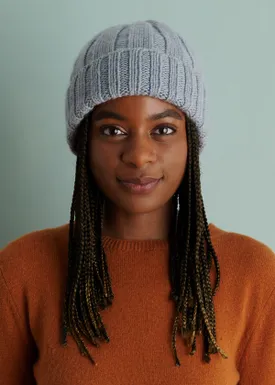
Whitney's 70's Ski Hat - The Pattern
This 70's style hat aids and abets in a little healthy nostalgia. Hockey on the pond, poma lifts to the top of the bunny slope, 6 feet of snow!
Gauge
5 stitches = 1 inch in st st using 1 strand of Cascade 220 and #7 needle
5.5 stitches = 1 inch in st st using 2 strands of 2 ply cashmere and #7 needle
Finished Size
20" circumference (to fit average man's head)
Provisional Cast-On
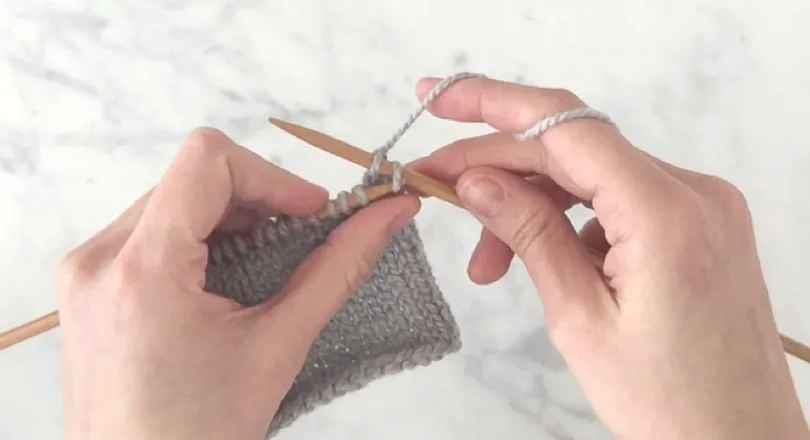
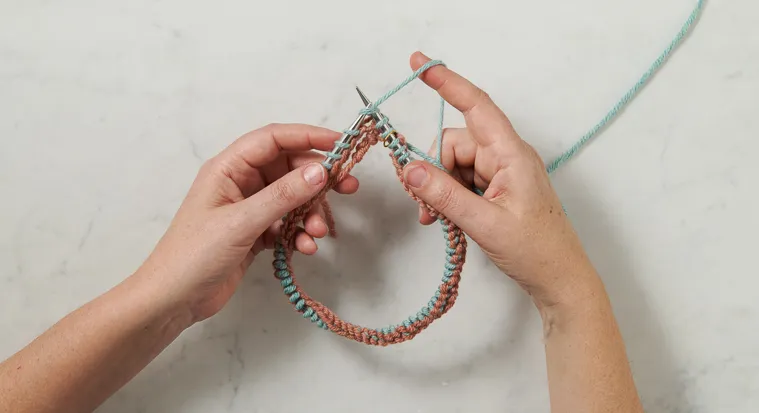
- Start with the waste yarn, and crochet a chain 120 stitches long. Using 2 strands of 2 ply cashmere and the #7 needle, pick up 110 stitches. (Please refer to the Provisional Cast-on tutorial if you are unfamiliar with this cast-on.)
Place a marker on the right needle and join for working in the round, being careful not to twist stitches around needle.
Knit 23 rounds with the two strands of cashmere.
Change to main color (MC).
Round 1: *K9, K2tog, repeat from * to end of rnd. (100st)
Round 2: Purl
Knit 10 more rounds
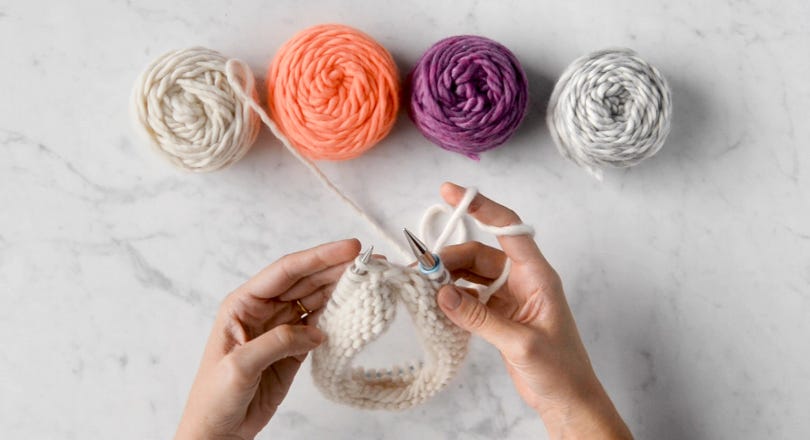
K5 rounds with color A
K4 rounds with color B
K3 rounds with color C
Weave in all the ends.
Place the provisional cast-on onto the smaller circular needle (see the Provisional Cast-on Tutorial).
Fold the cashmere hem up inside the hat so that the two circular needle are parallel to each other.

Change to MC.
Next round: *K 1 stitch from the front needle and 1 stitch from the back needle together 9 times, K 1 stitch from the front needle and 2 stitches from the back needle together 1 time, repeat from * to end of round (100 stitches).

With MC knit until hat measures 6-inches from hem edge.
Next round: K1, SSK, K45, K2tog, place marker, K1, SSK, K45, K2tog.
Next round: K1, SSK, K to 2 stitches before next marker, K2tog, slip marker, K1, SSK, K to 2 stitches before end-of-the-round marker, K2tog.
Repeat this last round until there are 20 stitches left, switching to double pointed needles when necessary.

Slip stitches so that the first 10 stitches are on 1 needle and the second 10 stitches are on another needle.
Cut an 18-inch tail.
Bring the needles inside the opening at the top of the hat (yes, this is a kind of weird manouever), and turn the hat inside out.
Hold the two needles parallel and knit a three needle bind off. (You do this by knitting one stitch from the front needle together with one stitch from the back needle 2 times. Then pass the first stitch over the second, just like a normal bind off...)
Finally, I do something that I admit is a little control freakish. I don't like the idea of someone wearing this hat with the jogged stripe side in the front, so I tie a little piece of yarn on the hem that says "This is the back of the hat!"
All that's left is to weave in the ends, block the hat, and make a few more!


Reader Comments (18)
My sister recently thrifted a patchwork coverlet made from 70s hat-and-sweater scraps, many with logos from various Colorado resorts. If I make one of these hats, I'm going to be tempted to do a colorwork rooster or something on it :)
Nati
My husband's head is also 23 inches, and the 70's hat fits him great. I designed the hat a little smaller than an average man's head so that the hat would stretch for a snug, warm fit. I think you're all set and don't have to worry about making any changes to the pattern.
But, just for your information, there are 2 basic ways to change a pattern's size. One is to knit at a bigger or smaller gauge than the pattern uses, and the other is to actually change the number of stitches you cast on and use.
For the first method, you would divide the number of cast on stitches (110) by the final measurement you're trying to achieve (say, for a woman 18"). The result of that calculation (6.1) is the number of stitches per inch you want to knit at. In this example, you would probably want to use a different yarn rather than just change needle sizes.
The second method is usually a bit more complicated. You would have to alter most of the stitch counts in the pattern by the percentage of change you want to make in the size (in our example, 18" is 10% smaller than 20", so you would cast on 10% fewer stitches). Sometimes, if there is a stitch pattern or evenly spaced decreases, you have to be sure to change your stitches by denominations that are divisible by a certain number (a simple example would be if you're knitting a 2 x 2 rib in the round, you would make sure to cast on a number of stitches that is divisible by 4).
Lots to take in, I know... For simple patterns like this one, it's a lot easier than it sounds!
Thanks for the great question, Whitney
Thanks Whitney!
You can check it out on my ravelry page http://www.ravelry.com/projects/mymaille